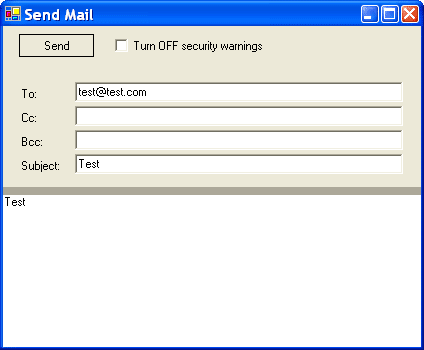
Symantec helps consumers and organizations secure and manage their information-driven world. Our software and services protect against more risks at more points, more. A program is trying to send an email message on your behalf. The two prompts read 'A program is trying to access e-mail address. Registry editing to.
These warnings started popping up on my system after installing a utility which synchronizes my Outlook Contacts with Google Contacts. Fortunately, I found a safe way to eliminate the warnings from Outlook, while keeping it protected from malware. It turned out the warnings were not caused by that utility itself. They occurred because Outlook, for some reason, was not (yet) recognizing my anti-virus program as valid. Here's how I solved it.
Tinyumbrella For Windows 7 32bit here. 1) Open Outlook 2010, go to ' File/Options/Trust Center' menu item, and then click on the ' Trust Center Settings' button at the right side of the dialog box. 2) From there, select the ' Programmatic Access' menu item.
At the bottom of this dialog, note what your ' Antivirus status' is. If it is ' Invalid' then close Outlook, navigate to where its 'OUTLOOK' program icon is on your disk (typically it sits in the 'Program Files (x86)/Microsoft Office' folder), and then right-click this icon and select ' Run as administrator' from the pop-up-menu. If you get a warning, then select 'allow' or 'yes' to continue. 3) Then in Outlook, go back to Programmatic Access as described above, and you should see your antivirus status updated to ' V alid' (assuming you have an up-to-date antivirus program on your computer). 4) Exit Outlook. Then open it the way you usually do. The warnings should now be gone.
This way, your Outlook application will be protected from malware, and you should no longer see warnings when other applications try to access Outlook. These warnings started popping up on my system after installing a utility which synchronizes my Outlook Contacts with Google Contacts. Fortunately, I found a safe way to eliminate the warnings from Outlook, while keeping it protected from malware. It turned out the warnings were not caused by that utility itself. They occurred because Outlook, for some reason, was not (yet) recognizing my anti-virus program as valid. Here's how I solved it. Crocodile Technology 3d Serial Number. 1) Open Outlook 2010, go to ' File/Options/Trust Center' menu item, and then click on the ' Trust Center Settings' button at the right side of the dialog box.
2) From there, select the ' Programmatic Access' menu item. At the bottom of this dialog, note what your ' Antivirus status' is.
If it is ' Invalid' then close Outlook, navigate to where its 'OUTLOOK' program icon is on your disk (typically it sits in the 'Program Files (x86)/Microsoft Office' folder), and then right-click this icon and select ' Run as administrator' from the pop-up-menu. If you get a warning, then select 'allow' or 'yes' to continue. 3) Then in Outlook, go back to Programmatic Access as described above, and you should see your antivirus status updated to ' V alid' (assuming you have an up-to-date antivirus program on your computer). 4) Exit Outlook. Aw Conqueror Carved One. Then open it the way you usually do. The warnings should now be gone.
This way, your Outlook application will be protected from malware, and you should no longer see warnings when other applications try to access Outlook. This didn't work for me. Then found this solution on the net: it worked for me: 1. Go to Control Panel and click on System and Security, then Administrative Tools.
Click on Services. Stop these services: Security Center Windows Managament Instrumentation SBSD Security Center Service (if you use Spybot Search & Destroy). Delete the directory C: Windows System32 wbem Repository 5.